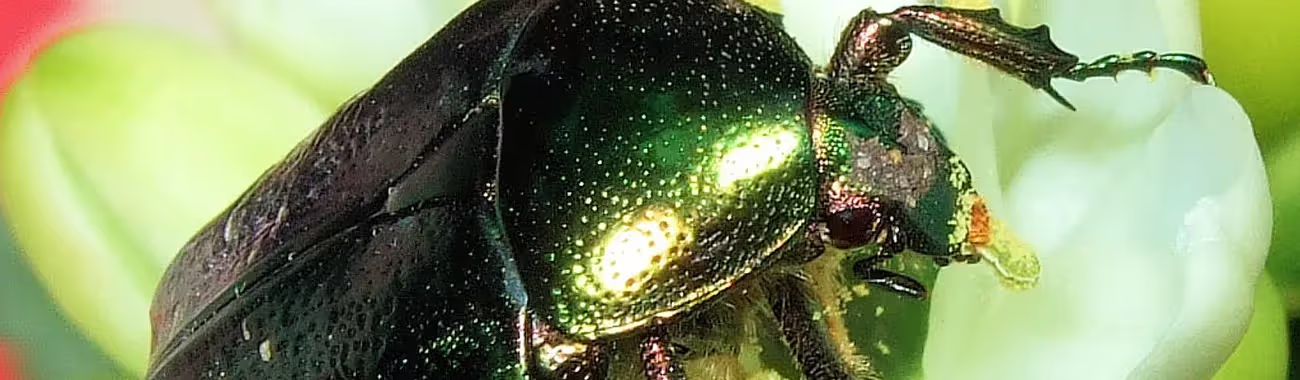

Minibeasts come in a huge range of size, shape and colour. They are grouped according to their characteristics. For example, the members of the largest group, the arthropods, all have legs with joints. Four classes of invertebrates belong to this group. These are:

There are four more classes of invertebrates:


All the examples in each class have similar characteristics, although it may not seem too obvious unless you study their body structure very closely.
By far the largest group of all is the insects, 22,450 species living in Britain alone. To qualify as an insect, an animal must have 6 legs and a body divided into 3 parts – a head, a thorax and an abdomen.
To be an arachnid, an animal must have 8 legs. Insects and arachnids are probably the easiest minibeasts to classify.
Looking at the list of examples above you will see that invertebrates vary greatly in size, ranging from a tiny mite to a huge octopus! It’s difficult to think of an octopus as a minibeast!
Generally speaking of course, when referring to minibeasts, we are talking about the small ones we find around us, in the garden, park, countryside, school grounds and the house. It is these we will investigate in some detail.


Explore Related Resources















Our Supporters




.avif)